



On Friday the 25th of November 2016 I gave a talk for the Scottish Philosophy and Psychiatry Special Interest Group.
My subject was “Improvement Science”.
The following is based on the slides and the four short films that I presented.
My talk was entitled:


The meeting was held at the Golden Lion Hotel, Stirling:


I started the day off:

I gave these declarations:


I explained to the audience that like Dr Rev I M Jolly I can be overly pessimistic [to watch Dr Jolly please click here or on the image below]:


The dictionary definition of ‘Improvement’:

The dictionary definition of ‘Science’:


The Health Foundation have considered Improvement Science: this is from 2011:

Many different terms are used including “QI” for “Quality Improvement”:

This is where improvement science began, in Boston, Massachusetts:


The Founder of the Institute for Healthcare Improvement (IHI) was Don Berwick:


The first description of this movement in Britain goes back to 1992 by Dr Godlee:

Fifteen years later, Dr Godlee, Editor of the BMJ, said this:


Only last month the BMJ briefly interviewed Don Berwick:

IHI describes improvement science as being based on a “simple, effective tool”:

This tool was developed from the work of an American engineer, W. A. Deming:

The “Model for Improvement” Tool [TM] is described by IHI as a “simple, yet powerful tool”:

The current President and CEO of IHI is Derek Feeley:

Up until 2013, Derek Feeley was Chief Executive [Director General] for NHS Scotland:

In April 2013 Derek Feeley resigned from NHS Scotland:

22nd February 2015 it was reported: “The astonishing and largely hidden influence of an American private healthcare giant at the heart of Scotland’s NHS”:


Dr Brian Robson, Executive Clinical Director for Healthcare Improvement Scotland [HIS] is an “IHI Fellow”:

Professor Jason Leitch, National Clinical Director for the Scottish Government is an “IHI Fellow”:


Might we be facing the biggest change to healthcare in Scotland since the NHS began?

Improvement science is moving quickly and widely across Scotland:

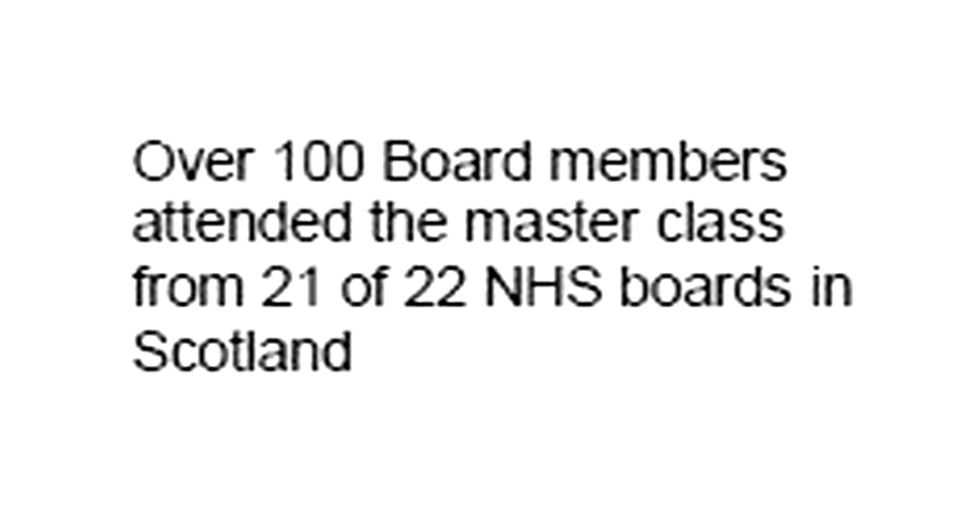
This “Masterclass 1” for Board members cost £146,837:


An NHS Board member commented after the Masterclass:


Healthcare Improvement Scotland is one organisation with a very wide remit over NHS Scotland and it works closely with the Scottish Government:


Nine cohorts of Safety Fellows and National Improvers have so far been trained following IHI methodology:


I was reminded of the current enthusiasm for improvement science when the Convener of a recent Scottish Parliament Committee meeting said of targets (another approach enthusiastically taken by NHS Scotland):

What is the place of ethics in Improvement Science?

In 2007 the Hastings Centre, USA, looked into this in some depth:

The Hastings Centre argue that Improvement science cannot ignore ethics:


In 2011 the Health Foundation, UK, produced this “Evidence Scan”:


The Health Foundation commented that “improvement science is just emerging”:


I would also suggest that there is a real paucity of philosophy about the field of improvement science:

The Health Foundation did find papers on the conceptual nature of Improvement Science but concluded that:

Mary Midgley is a philosopher now aged 95 years who is widely respected for her ethical considerations:

Chapter 7 of her book “Heart and Mind: The Varieties of Moral Experience” begins:

Mary Midgley is concerned about the overuse of reductionist tests in medicine stating that:

This film is about the potential consequences of inappropriate reductionism:

[To play Mary’s Coloured Jars please click here or on the image above]
Leon Eisenberg has written many papers about this subject. He argues that reductionism should not be “abandoned” but that we must keep sight of where such an approach is scientifically useful and also where it is inappropriate:


In the Hastings Report, Margaret O’Kane asks:

In my view the answer to this question is YES. I am hopeful that the National Improvers recruited to NHS Scotland would agree:

As an NHS doctor I have seen unintentional harm brought about by National improvement work in Scotland. This related to a “Screening Tool” that was introduced across Scotland as part of this work. I found that the unintended consequences of the use of the following tool included implications for patients’ autonomy and the risk of over treatment:


Both the Hasting Group and the Health Foundation are of the view that improvement science cannot separate itself from the ethical requirements of research:

This article published in February 2016 argues that individual “rights transcend all aspects of Improvement science”

The following is a verbatim representation of a conversation held by National Improvers working in NHS Scotland:

In November 2016 Professor Joshi, also a psychiatrist outlined his concerns about reductionism in a published letter to the BMJ:


In this short film the mechanical language of healthcare improvers is considered:

Professor John Bruce was a Moral Philosopher in Edinburgh University in the 18th century. He built this temple, the “Temple of Decision”, in the grounds of his home by Falkland Palace so that he could consider his thesis:

Professor John Bruce did not succeed in his endeavour. His Temple however stood for many years:

But it eventually collapsed and his endeavour to “reduce the science of morals to the same certainty that attends other sciences” collapsed with it.

Any search of Healthcare Improvement Scotland for “ethics” finds this result:

This film is about more up-to-date buildings – the enthusiasm for which was based on improvement science: The Red Road flats in Glasgow:

To play Red Road Flats please click here.